
Accounting & Tax Services Sydney | TaxFlow Accounting Services

Category: Blog

Your blog category

  • Business Tax Accountant: 7 Powerful Reasons Your Company Needs Professional Tax Support

    Business Tax Accountant: 7 Powerful Reasons Your Company Needs Professional Tax Support

    What Does a Business Tax Accountant Do?

    A business tax accountant is a qualified professional who manages the tax obligations of companies, partnerships, trusts and sole traders. A bookkeeper records your day to day transactions. A tax accountant goes further and focuses on compliance, strategy and long term tax savings.

    Here are the core tasks they handle:

    • Preparing and lodging company, trust and partnership tax returns
    • Preparing Business Activity Statements (BAS) and managing GST
    • Managing PAYG withholding and PAYG instalments
    • Advising on superannuation guarantee obligations for staff
    • Handling Fringe Benefits Tax (FBT) returns
    • Providing year round tax planning and business structure advice
    • Representing your business during ATO reviews and audits

    In Australia, only a registered tax agent can charge a fee to prepare and lodge tax returns for you. You can confirm an accountant’s registration on the Tax Practitioners Board register.
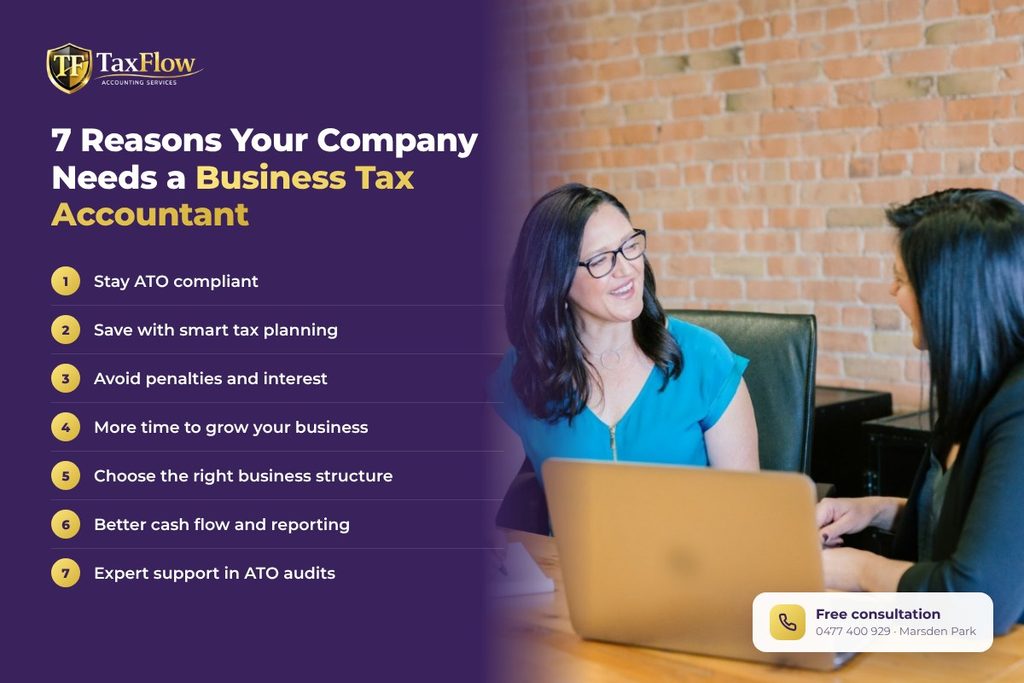
    business tax accountant meeting a client, with 7 reasons your company needs professional tax support

    7 Reasons Your Company Needs a Business Tax Accountant

    1. Stay Compliant With Changing ATO Rules

    Australian tax law changes almost every financial year. Thresholds move, new reporting rules start and concessions are extended or removed. Keeping up while you run a business is hard.

    A good tax adviser tracks these updates for you and applies them to your records. Your returns, BAS and payroll reporting stay accurate and on time. You can also read the latest official guidance on the ATO website for businesses.

    2. Save Money With Smart Tax Planning Services

    Good tax planning happens before 30 June, not after it. Professional tax planning services look at your whole financial year and find legal ways to reduce the tax your company pays.

    Your accountant can help you:

    • Claim every deduction your business is entitled to
    • Time major purchases and expenses for the best tax outcome
    • Use small business concessions where you qualify
    • Plan director salaries, dividends and super contributions
    • Avoid surprise tax bills at the end of the year

    Many business owners find that the savings from proactive tax planning are greater than the cost of the accountant.

    3. Avoid Costly Penalties and Interest

    Late lodgements, wrong GST claims and unpaid PAYG withholding can trigger ATO penalties and general interest charges. These costs add up fast and hurt your cash flow.

    A professional tax adviser keeps a calendar of every lodgement and payment date. Registered tax agents can also access the ATO lodgement program, which may give your business extra time for some returns.

    4. Get More Time to Grow Your Business

    Every hour you spend on receipts, BAS forms and tax rules is an hour taken away from sales, customers and your team. Handing tax work to a qualified professional frees up that time.

    You make better decisions when you are not stressed about compliance. Your accountant takes care of the detail while you focus on growth.

    5. Choose the Right Business Structure

    Your structure affects how much tax you pay, how you protect your assets and how easily you can grow. Sole trader, partnership, company and trust structures are all taxed differently.

    An experienced tax accountant reviews your income, goals and risk level and recommends the structure that fits best. They can also advise you when it is time to restructure as your company grows.

    6. Improve Cash Flow and Financial Reporting

    Tax is closely linked to cash flow. GST, PAYG instalments and income tax payments all affect the money available in your bank account.

    Professional accounting services give you clear reports on profit, cash and tax owing. With accurate numbers, you can plan payments ahead, apply for finance with confidence and spot problems early.

    7. Expert Support During ATO Audits and Reviews

    An ATO review or audit can be stressful, even when your records are in order. A registered tax agent knows what the ATO will ask for and how to respond.

    Your adviser can prepare documents, talk to the ATO on your behalf and help resolve issues quickly. That support protects your time and your reputation.

    Business Tax Accountant vs Bookkeeper: What Is the Difference?

    Both roles are valuable, but they do different jobs. Here is a simple comparison:

    TaskBookkeeperTax Accountant
    Record daily transactionsYesSometimes
    Reconcile bank accountsYesReviews
    Prepare and lodge BASOnly if a registered BAS agentYes
    Lodge company tax returnsNoYes
    Tax planning and strategyNoYes
    Business structure adviceNoYes
    ATO audit supportNoYes

    Many growing companies use both. The bookkeeper keeps records clean, and the tax accountant turns those records into compliance and savings.

    What Records Should You Give Your Accountant?

    Good records make tax time faster and cheaper. Before your first meeting, gather these documents:

    • Bank and credit card statements for the financial year
    • Sales invoices and supplier bills
    • Payroll reports and superannuation payment records
    • Loan statements and asset purchase invoices
    • Previous tax returns, BAS and any ATO letters
    • Access to your Xero, MYOB or QuickBooks file

    If your records are incomplete, do not worry. A good accountant will help you organise them and set up simple systems so next year is easier.

    Signs You Need a Business Tax Accountant Now

    You may need professional tax support sooner than you think. Watch for these signs:

    • Your turnover has grown and your tax affairs feel complicated
    • You have registered for GST or started hiring staff
    • You received a letter or penalty notice from the ATO
    • You are unsure which expenses you can claim
    • You want to buy property, equipment or vehicles through the business
    • You spend hours every quarter on BAS and still feel unsure

    If any of these sound familiar, it is the right time to speak with a qualified adviser.

    How to Choose the Right Business Tax Accountant in Sydney

    Not every accountant is the right fit for your company. Use this checklist when you compare options for accounting services in Sydney:

    1. Registered tax agent: Check the Tax Practitioners Board register before you sign up.
    2. Business experience: Look for an accountant who works with companies in your industry.
    3. Cloud accounting skills: Your accountant should work with Xero, MYOB or QuickBooks.
    4. Proactive advice: Choose someone who contacts you before 30 June, not only at lodgement time.
    5. Clear pricing: Ask for fixed fees or a clear quote so there are no surprises.
    6. Local knowledge: A local tax accountant understands the businesses and challenges in your area.

    If you are based in western Sydney, working with a tax accountant in Marsden Park means you can meet face to face whenever you need to.

    Why Choose TaxFlow as Your Business Tax Accountant

    TaxFlow Accounting Services supports small and medium businesses across Sydney with practical, friendly tax advice. As your business tax accountant, our team helps you lodge on time, reduce tax legally and understand your numbers.

    Our services include:

    • Company, trust and partnership tax returns
    • BAS, GST and PAYG reporting
    • Tax planning services before the end of the financial year
    • Bookkeeping and cloud accounting setup
    • Business structure and growth advice

    Whether you need a tax accountant in Marsden Park or anywhere in Sydney, TaxFlow is ready to help your company grow with confidence.

    Frequently Asked Questions

    How much does a business tax accountant cost?

    Fees depend on the size of your business, the number of entities and the services you need. Many firms offer fixed fee packages for tax returns, BAS and tax planning. Ask for a clear quote before you start.

    When should I hire a business tax accountant?

    The best time is before problems appear. Most companies benefit from professional help as soon as they register for GST, hire staff or set up a company or trust.

    Can a business tax accountant lodge my BAS?

    Yes. A registered tax agent can prepare and lodge your BAS and manage your GST and PAYG obligations with the ATO.

    Do I still need an accountant if I use Xero or MYOB?

    Yes. Software records your transactions, but it cannot plan your tax, choose your structure or represent you in an ATO review. A tax accountant uses your software data to give you real advice.

    Conclusion

    A business tax accountant is one of the smartest investments a growing company can make. You stay compliant with the ATO, avoid penalties, pay less tax through smart planning and gain more time to grow your business.

    Ready to take the stress out of tax? Contact TaxFlow Accounting Services today and speak with an experienced business tax accountant in Sydney.

  • How Professional Accounting Services Help Sydney Businesses Grow

    How Professional Accounting Services Help Sydney Businesses Grow

    The accounting services Sydney businesses use to grow often start with a practical question. Can we afford to hire, buy more stock or take on a bigger job? A Western Sydney trades business might finish a job on Friday, pay wages and suppliers the next week, and wait another month for the invoice to clear. A profitable job can still leave the business short of cash between those dates.

    Professional business accounting services help owners keep reliable records, understand margins and prepare for BAS and tax payments. A small business accountant Sydney owners can work with throughout the year can help turn those records into a monthly review. For decisions such as hiring or signing a lease, business advisory services help estimate costs and compare scenarios before you commit.

    A useful place to start is to write down one decision you need to make in the next three months. It might be replacing equipment, renegotiating a supplier agreement or opening on an extra day. Then ask which report, forecast or missing record would help you decide. The seven steps below show what to look for.

    TaxFlow accounting services Sydney growth guide with the Opera House and Harbour Bridge at dusk.

    1. Make bookkeeping part of business accounting services

    Reliable bookkeeping starts with recording transactions consistently, reconciling bank accounts and checking outstanding invoices. With current records, you can see which customers owe you money, which supplier bills are due and whether a jump in spending comes from a one-off purchase or a recurring cost.

    Take a Sydney retailer selling through a shop and a website. The payment platform may deposit several days of sales in one amount after refunds and fees. The bank deposit alone cannot explain how much stock was sold, what customers returned or what the platform charged. Matching the settlement report to orders and then to the bank deposit gives the owner a clearer sales picture and makes discrepancies easier to investigate.

    Start your monthly review with a short list.

    • Match bank and card activity to the accounting records.
    • Review unpaid customer invoices and query old balances.
    • Check supplier bills, credits and payments that have been recorded twice.
    • Save invoices, receipts and evidence of business expenses where you can find them.
    • Ask about uncategorised transactions before closing the month.

    The Australian Taxation Office (ATO) generally requires businesses to keep most tax records for five years. Some records must be retained longer, so check the rules that apply to your records. ATO overview of business record-keeping rules

    If bank reconciliations are a few months behind, ask which periods need attention first and agree who will provide the missing information. Keeping that responsibility clear makes it easier to maintain the records once the backlog is cleared. TaxFlow’s bookkeeping services in Sydney

    2. Forecast cash flow before you commit to growth

    As part of business accounting services, a cash flow forecast estimates when money will arrive and when payments will fall due. It usually starts with your bank balance, then adds expected receipts and subtracts payments such as wages, rent, supplier invoices, loan repayments and tax. A weekly view can reveal a shortfall before a month-end forecast would show it. Australian Government guide to cash flow forecasting

    Suppose a business begins the month with $25,000 in the bank, expects $18,000 from customers and must pay $35,000 in bills. Its forecast closing balance is $8,000. If one $8,000 customer payment moves into next month, the forecast buffer drops to zero.

    Forecast componentOn-time paymentCustomer pays late
    Opening cash$25,000$25,000
    Customer receipts this month$18,000$10,000
    Bills due this month$35,000$35,000
    Forecast closing cash$8,000$0

    The owner could use that forecast to time a stock order, ask about a staged supplier delivery or follow up on the invoice before approving a purchase. Dates matter within the month too. If payroll is due before the larger invoices are expected to clear, a positive month-end balance may still leave a gap during the month.

    A forecast is one of the accounting services Sydney businesses can use even when sales are steady. Update it when a customer pays late, a large job moves or you approve a new expense. If sales are seasonal, compare your estimates with the same period last year and adjust for changes in staffing, prices and costs. TaxFlow’s cash flow forecasting and accounting support

    3. Use financial reports to improve prices and margins

    Rising sales can make a business look healthier even when some jobs or products earn less than expected. A café could sell more through delivery apps and keep less from each order after fees, packaging and discounts. A trades business might quote a profitable-looking job that consistently needs extra labour or return visits.

    Compare revenue and direct costs by service, job type or sales channel. A café, for example, might receive $24 on an order and incur $9 in ingredients and packaging, $6 in platform fees and $4 in direct labour. That leaves $5 towards rent, utilities and other overheads. This simplified comparison can help the owner decide whether to adjust the menu, pricing or delivery mix.

    ReportWhat to reviewDecision it can support
    Profit and loss statementSales, direct costs, margins and overheadsWhether to change prices or review a cost
    Balance sheetCash, amounts owed, inventory and liabilitiesWhether the business can carry additional stock or debt
    Cash flow forecastExpected receipts and payments by dateWhen to schedule a purchase, hire or payment
    Accounts receivable ageingHow long customer invoices have been outstandingWhich customers to follow up with first

    Start with the latest month and compare it with a relevant period. For a seasonal retailer, the same month last year may tell you more than the previous month. Check the reasons behind a change before acting. A one-off maintenance bill, a change in product mix and a lasting increase in supplier costs call for different decisions.

    Ask your accountant to explain the reports in terms of your operations. For example, if labour costs rose faster than sales, look at staffing hours, job duration and billed time before changing hourly rates. TaxFlow’s business accounting services include financial statements and performance analysis. TaxFlow’s financial reporting and accounting services

    Check what changed before revising prices

    Run a small trial before adjusting prices across the business. A café could start with the items that sell often and have the thinnest margins. A contractor could update the labour allowance on one common job and compare the next few quotes with actual hours worked. Keep track of whether customers book at the new price as well as how much the business earns on completed work. This gives you a basis for deciding whether to widen the change.

    4. Prepare for BAS and tax throughout the year

    A business activity statement (BAS) can cover goods and services tax (GST), pay as you go (PAYG) withholding and PAYG instalments, depending on your obligations. Check the due date on your statement and confirm which amounts you need to report. ATO guidance on business activity statements

    Keeping records current makes it easier to check the figures before lodging. That includes reviewing GST coding where applicable, matching transactions to supporting documents and resolving differences between payroll reports and the accounting records. Ask your adviser which records they need and when to send them.

    It also helps to add expected tax payments to the cash forecast. For a business preparing to buy equipment, seeing a BAS payment and a supplier deposit in the same week can change the timing of the order. If the amount is uncertain, use the best current estimate, note the assumption and revise it when you have an updated figure.

    Decide who handles each step. Your team might issue invoices and collect receipts while your accountant reviews the ledger and helps with reporting or lodgement within the agreed scope. A simple calendar can show when the records need to be ready before lodgement day. Keeping a list of queries also helps you identify recurring errors and fix them at the source. TaxFlow’s BAS lodgement services in Marsden Park

    5. Use business advisory services before you hire or expand

    The accounting services Sydney businesses use for routine reporting can give them a starting point for expansion planning. A growth decision usually adds costs before it brings in all the expected revenue. A new staff member may need training and equipment. A second site may require a bond and fit-out while sales build. Business advisory services can help you compare a base forecast with a slower scenario and see how long the business can cover the added costs.

    Before approving a hire or lease, review these assumptions.

    • How much will the business pay up front and each month?
    • How many additional jobs, orders or billable hours would cover those costs?
    • When will customers actually pay for the extra work?
    • What happens if it takes three months longer than planned to reach the sales target?
    • Which expenses can you delay if the cash forecast turns tight?

    For a Western Sydney trade business weighing up a second crew, test the cost of the vehicle, tools, wages and extra materials alongside expected billable hours. Include time that cannot be billed, such as training, travel between jobs and rework. Compare those costs with the actual number of jobs likely to come in each week and when you expect to be paid.

    A forecast can also help you compare commitments. Hiring at once may make sense where signed work is already in the diary. Taking equipment costs in stages may suit a business still testing demand. If the figures move when you adjust an assumption by a small amount, investigate that assumption before making the decision. TaxFlow’s business advisory services in Sydney

    Agree when to review an expansion decision

    Ask what would make you revisit the plan after the first month or quarter. For instance, you might review the new crew’s bookings after four weeks, pause a second equipment order if expected receipts fall short, or revise the forecast if training takes longer. Document these triggers while you still have time to change course. Business advisory services can help you choose measures that reflect the real costs and constraints of the expansion.

    6. Create a monthly review you can act on

    A monthly review is one way to get more value from business accounting services. It gives you a regular place to look at wages, customer receipts, sales and upcoming commitments. Keep the meeting short enough to run consistently. Start with what changed since the last review, identify what caused it and pick one or two actions with an owner and a due date.

    For a service business, a useful agenda might include the five largest outstanding invoices, work booked for the next six weeks, gross margin on completed projects and the lowest expected cash balance in the forecast. A café might instead track takings by channel, wage costs, food costs and major supplier payments. Choose measures that connect directly to decisions you control.

    Agree how you will check progress next time. If the action is to collect two late invoices, check the receipts and update the forecast. If the action is to tighten a quote template, compare quoted and actual labour on the next few jobs. This creates a record of what happened after a decision and makes the next review more grounded.

    When you outsource business accounting services, ask your provider what they need from you to close the month on time and when you can expect the reports. Have one person take responsibility for answering transaction queries. A report arriving after you have approved a major expense has less practical value than a simpler report you can use beforehand.

    7. Compare accounting services Sydney businesses can use as they grow

    The scope of accounting services Sydney businesses need varies with their staffing, transaction volume and plans. One business may need help catching up on reconciliations, while another may already keep reliable books and want monthly reporting or business advisory services. Explain which decision prompted your enquiry so the accountant can suggest a scope that fits.

    Ask these questions in an initial conversation with a small business accountant Sydney owners can work with locally or online.

    • Which tasks are included, and which incur a separate fee?
    • Who updates the records, prepares reports and follows up on queries?
    • How often will we meet to review results or refresh a forecast?
    • Can you work with our existing accounting software?
    • What experience do you have with businesses that have similar cash flow or reporting needs?

    A first meeting should cover the state of the books, immediate obligations and the next major decision. Bring your recent reports, a summary of overdue invoices and a list of planned purchases or hires. If you’re comparing quotes for accounting services Sydney firms provide, ask each firm to price the same reporting schedule and specify which work is billed separately.

    TaxFlow Accounting Services supports businesses in Melonba, Marsden Park and across Western Sydney. Its Sydney accounting service includes financial reporting, forecasting and ongoing advisory support. Explore TaxFlow’s business accounting services

    Decide which business accounting services to outsource

    The business accounting services you outsource should fit the way your team works. If you keep customer invoicing in-house, tell the accountant how quickly invoices are raised and who follows them up. If you outsource reconciliations, agree where staff should send receipts and how often they need to do it. A clear division of work helps avoid delays and gives both sides a simple way to check whether the handover is working.

    Frequently asked questions

    What do business accounting services typically include?

    Depending on the engagement, they may include financial statement preparation, cash flow forecasts, year-end reporting, reconciliation oversight and performance reviews. Confirm which services are included in your quote if you also need bookkeeping, payroll, BAS support or business advisory services. Check how frequently you’ll receive reports and whether there will be a meeting to review them.

    What’s the difference between bookkeeping and accounting?

    Bookkeeping records and reconciles daily transactions. Accounting uses those records to prepare financial statements, explain business performance and help you plan for tax and growth decisions. If transaction records are incomplete, it is harder to build reliable reports and forecasts. That’s why reviewing the condition of the books is a practical first step.

    How often should a small business review its finances?

    A monthly review is a practical starting point. Weekly cash flow checks may be helpful if sales are seasonal, a few customers account for most receipts or large payments are due soon. At each review, compare the last forecast with what actually happened and find out which receipts or costs differed.

    Can business advisory services help my business get ready to hire?

    An accountant can help estimate the total cost of a hire, test how quickly the role needs to generate revenue and compare the cash available under different scenarios. Bring your planned wages, start date, training expectations and any extra equipment costs. Include a slower scenario if you are relying on new orders to fund the position.

    Which accounting services do Sydney businesses usually start with?

    Many start with bookkeeping and periodic reporting, then add cash flow forecasts or business advisory services when they have a decision to make. If you are comparing accounting services Sydney firms offer, ask what each package includes and which work you will still need to handle internally.

    Can I change my accounting package as the business grows?

    Yes. When comparing accounting services Sydney firms offer, ask what it would cost to move from periodic reporting to monthly reviews or to add a rolling forecast. Agree when to review the scope, such as when you open a new location or add a sales channel that needs separate reporting.

    Plan your next move with TaxFlow Accounting Services

    Start with one decision you need to make. If you want to hire, bring your expected wages and upcoming work. If you’re reviewing prices, bring the sales and direct costs for one service or product. If cash is tight, bring your current bank balance, unpaid invoices and upcoming bills.

    TaxFlow Accounting Services can help you review those figures and decide which reports or forecasts you need next. Sydney business owners can get in touch to discuss bookkeeping, reporting, cash flow forecasting or ongoing business advisory services. Contact TaxFlow Accounting Services